Provence Real Estate: Why the Market Has Remained So Resilient
Dernière mise à jour : 9 mai
For years, Provence has often been viewed as an emotional purchase: a beautiful place to escape, slow down, and enjoy the South of France.
But over the past decade, the region has quietly demonstrated something else entirely:
its real-estate market has remained one of the most stable and structurally resilient in France.
While several European second-home markets experienced periods of speculation, oversupply or sharp corrections, Provence followed a much more controlled trajectory, driven by limited supply, strong international demand, and long-term lifestyle appeal.
For investors looking beyond short-term hype, this is precisely what makes the region increasingly interesting.
Table of Contents

The Key Market Figures Investors Should Know
Before looking at lifestyle or market perception, the numbers already reveal an important trend. According to INSEE and Notaires de France, the Provence-Alpes-Côte d’Azur (PACA) region has experienced steady long-term growth over the past decade, particularly for houses.
Key Indicators (PACA Region) | Recent Data |
📈 Existing home price index | +30% since 2015 |
🏡 House price index | Stronger growth than apartments |
🌍 International buyer demand | Stable over time |
🏖️ Secondary-home market | One of the strongest in France |
🏗️ New construction supply | Structurally limited in many areas |
📊 Market profile | Long-term appreciation rather than speculation |
👉 Unlike highly speculative markets, Provence has generally experienced gradual and relatively controlled growth rather than explosive price surges.
A Decade of Stable Growth, Not Speculation
One of the most interesting aspects of the Provençal market is the way prices have evolved.
The region did not experience the type of rapid speculative expansion seen in certain international coastal markets. Instead, property values have tended to rise progressively over time.
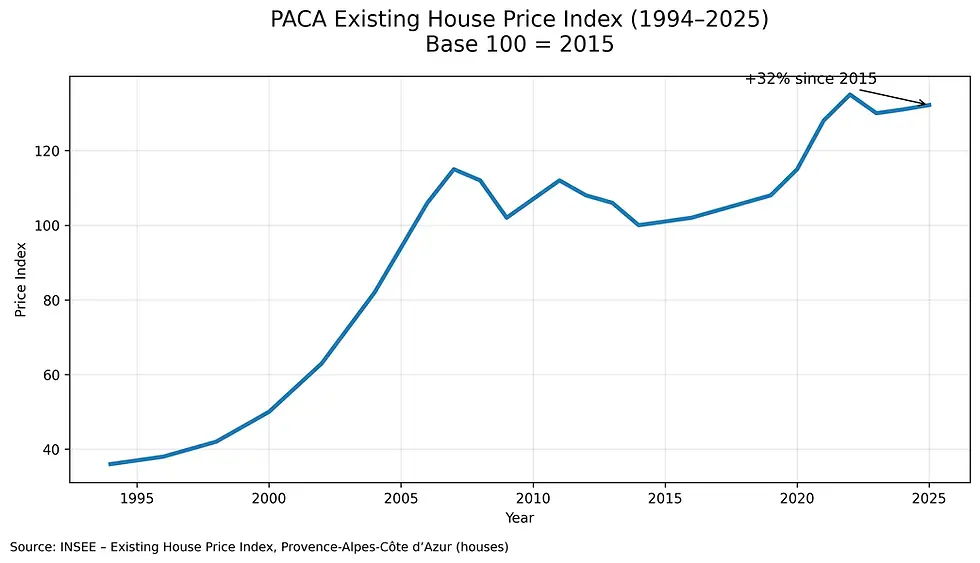
According to INSEE data, the PACA existing-home price index increased by approximately 30% between 2015 and 2025. For investors, this type of trajectory is often healthier than sudden price explosions.
Why?
Because stable growth usually reflects:
genuine demand
limited supply
long-term desirability
structural market strength rather than short-term speculation
In practical terms, Provence behaves more like a scarcity-driven patrimonial market than a high-volatility investment cycle.
Why Provence Continues to Resist Oversupply
This is probably the single most important factor behind the region’s resilience.
In many areas of Provence, large-scale expansion is naturally restricted by:
Structural Constraint | Impact on Property Supply |
🏛️ Strict planning regulations | Limits large-scale development |
🌿 Protected landscapes | Preserves long-term scarcity |
🍇 Agricultural land preservation | Restricts construction expansion |
⛰️ Topography | Limits buildable land |
🏡 Controlled village development | Reduces oversupply risk |
Even when construction activity increases, much of the new supply is concentrated in collective housing rather than the type of detached villas most international buyers seek. This helps explain why international demand in Provence tends to remain focused on long-term quality, scarcity and lifestyle stability rather than speculative expansion.
This distinction partly explains why villas continue to attract sustained long-term demand in Provence, particularly compared to apartments in more densely developed markets, a difference explored further in Why Buy a Villa in Provence Rather Than an Apartment?
The Strength of International and Lifestyle Demand
One of the reasons the Provençal market has remained resilient over time is that demand is supported by a highly international buyer base rather than local demand alone.
And for many foreign buyers, Provence offers advantages that are becoming increasingly difficult to find in their domestic markets.
🇬🇧 If you are investing from the UK, Provence may offer access to detached villas, land and outdoor amenities that have become increasingly expensive in many premium British markets, while also benefiting from strong long-term international demand.
🇨🇭 If you are investing from Switzerland, the region combines geographic proximity with comparatively larger properties and a market historically perceived as stable and patrimonial.
🇧🇪 If you are investing from Belgium, Provence offers a well-established second-home market with relatively easy accessibility and strong long-term family ownership appeal.
🇺🇸 If you are investing from the United States, Provence provides access to a mature European real-estate market where scarcity, protected landscapes and strict planning regulations naturally limit oversupply.
🇸🇪 🇩🇰 🇳🇴 If you are investing from Northern Europe, Provence combines climate appeal with property types, villas, gardens, pools and outdoor living spaces, that remain structurally limited in many highly urbanised northern markets.
Tourism also plays an important indirect role in this dynamic.
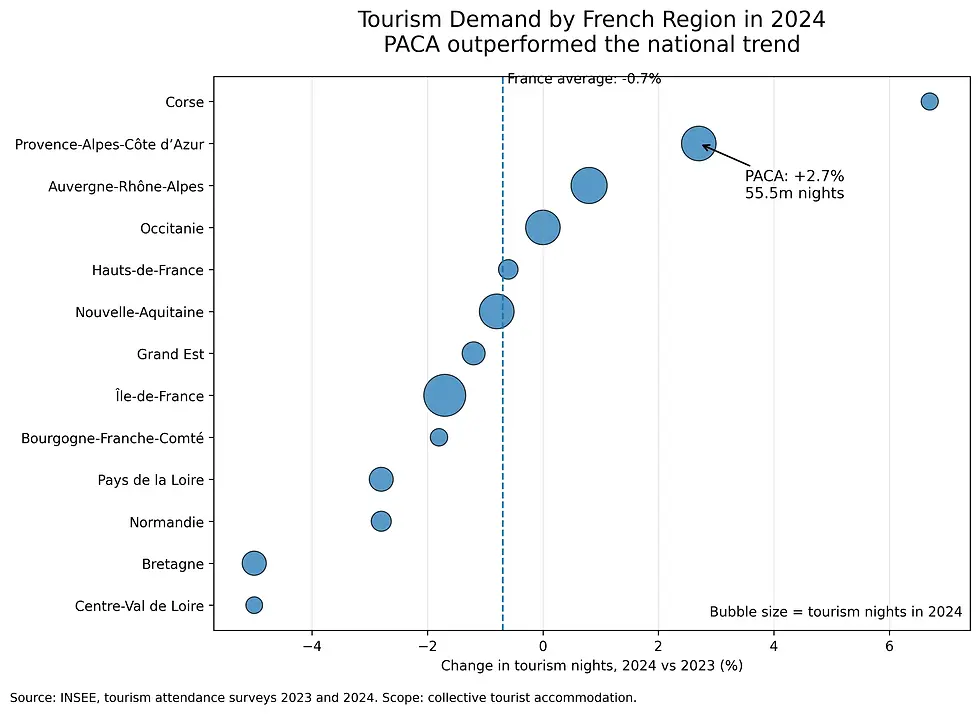
As shown in the INSEE data below, the Provence-Alpes-Côte d’Azur region continued to outperform the national tourism trend in 2024, with visitor numbers rising while several other French regions experienced stagnation or decline.
This matters for investors because strong tourism demand helps maintain:
🌍 international visibility for the region,
📈 long-term rental demand,
💶 resale liquidity for high-quality properties.
In practice, villas combining privacy, outdoor space, swimming pools and authentic Provençal character remain among the most sought-after property types for both international visitors and long-term buyers.
What Investors Should Watch Carefully
None of this means Provence is a “risk-free” market.
And serious investors should avoid approaching the region emotionally alone.
Several points deserve careful attention before purchasing, particularly when evaluating older villas or countryside properties where practical constraints can strongly influence long-term ownership costs. These aspects are explored further in Buying Property in Provence: What Foreign Buyers Should Really Check.
Point of Attention | Why It Matters |
🏠 Renovation costs | Older villas can require significant upgrades |
🌿 Maintenance | Pools, gardens and outdoor spaces generate ongoing costs |
📜 Urban planning rules | Extensions and renovations may be restricted |
🔥 Climate exposure | Certain areas face drought or wildfire risks |
💶 Financing conditions | Interest rates remain higher than during the ultra-low-rate years |
🧾 Taxation and succession | Cross-border ownership should be properly structured |
The market rewards quality, patience and long-term ownership far more than short-term speculation.
A Personal Note 💬
💡My advice
When evaluating property in Provence, focus less on short-term price movements and more on long-term scarcity.
In many sought-after areas, what protects value over time is not rapid growth, but the limited ability to recreate the same type of property nearby.
🌍 Did you know?
The Provence-Alpes-Côte d’Azur region has one of the highest concentrations of second homes in France, with nearly twice the national average, a strong indicator of the region’s long-term international appeal and structural demand.


Commentaires