Seeing Lavender in Provence: The Best Time & Places
Dernière mise à jour : 1 avr.
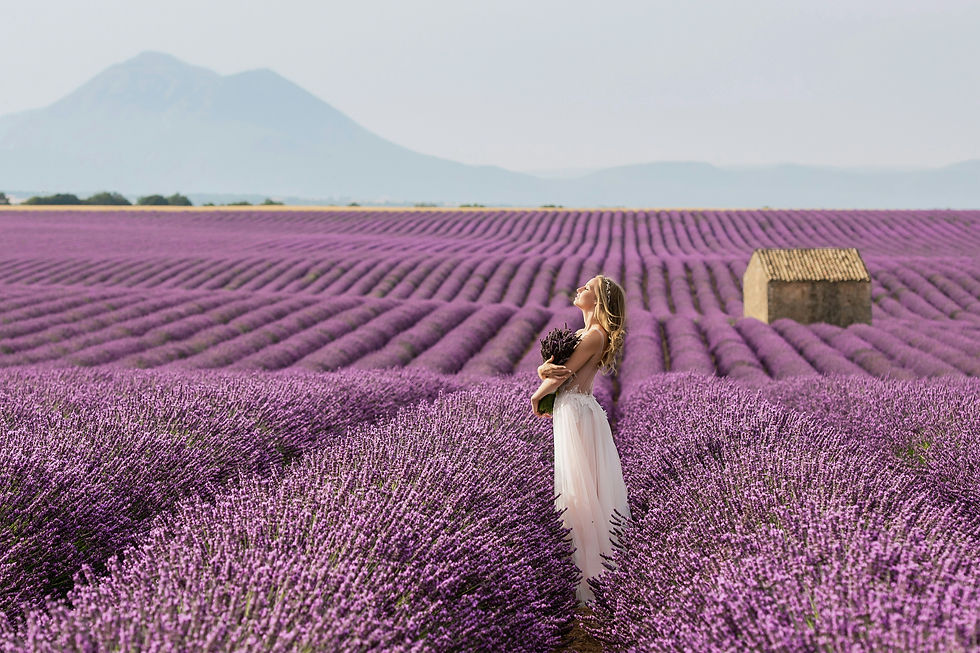
If you’re wondering when and where to see lavender fields in Provence, the most accurate answer is this: late June to mid-July, in specific inland areas of Provence, away from the coast.This short window is when lavender is in full bloom and at its most photogenic — before the harvest begins.
But lavender in Provence is more than a beautiful landscape. It follows a precise agricultural cycle, grows only in certain conditions, and is deeply rooted in local life. Understanding this makes the experience far more rewarding.
Table of contents

1. Why lavender grows in Provence
Lavender doesn’t grow in Provence by chance. It belongs here because the land and climate suit it perfectly — and because it has adapted to conditions that many other plants would struggle with.
Provence offers dry air, intense sunlight, and poor, rocky soils, especially limestone. These may seem harsh, but for lavender, they are ideal. Too much water or rich soil would actually weaken the plant and dilute its scent.
For lavender to thrive, it needs:
Low humidity, which keeps the plant healthy and prevents disease
Cold winters and hot, dry summers, essential for its natural cycle
Well-drained, often stony soils, where roots never sit in water
Moderate altitude, usually between 500 and 1,200 meters (1,600–4,000 ft)
This is also why lavender is rarely found near the coast. Areas like the French Riviera are too humid, too mild in winter, and not suited to its needs. Lavender prefers the quieter, wind-swept plateaus and backcountry hills, where conditions are tougher — but more authentic.
In many ways, lavender reflects Provence itself: resilient, shaped by the climate, and deeply connected to the land it grows on.

2. Where to find lavender fields in Provence
Lavender fields are mainly found in inland Provence, where altitude, dry soils, and climate conditions are ideal for cultivation. Unlike the coast, these areas offer vast open landscapes where lavender is grown as an agricultural crop, not as a decorative feature.
The main regions where lavender can be found include:
Valensole Plateau (Alpes-de-Haute-Provence)This is the most iconic lavender area in Provence, known for its wide, geometric fields stretching across open plateaus. It is also the most photographed region, especially during peak bloom.
Haut-Var and backcountry ProvenceIn the inland Var, lavender appears in smaller, more discreet plots integrated into a rugged Provençal landscape. These fields are part of working farms and tend to feel more authentic and less staged.
Drôme ProvençaleThis northern Provençal area combines lavender fields with vineyards, olive groves, and medieval villages. Lavender here is widely cultivated but spread across rolling hills rather than large plateaus.
Luberon foothills (smaller areas)In the Luberon, lavender fields are more scattered and often mixed with other crops. While visually stunning, these areas are smaller in scale compared to Valensole.
A note for visitors staying near Fréjus
For those based near the coast, including around Fréjus, the closest lavender landscapes are found inland, particularly in the Haut-Var. While these fields are less expansive than those in Valensole, they offer a quieter, more genuine glimpse of Provence’s agricultural heritage and are often overlooked by mass tourism.
The Valensole Plateau remains the most famous, but it is also the busiest. Travelers seeking a more peaceful experence often prefer the inland Var or other lesser-known Provençal backcountry areas.
⚠️ Important: lavender fields are working farms, not tourist attractions. Access, visibility, and planting locations can change from year to year depending on agricultural cycles and harvest conditions.
3. Lavender growing cycle
Lavender is a perennial plant with a very regular rhythm:
Winter: dormant
March–April: new growth
May–June: flower stems develop
Late June–July: flowering
July–August: harvest
Autumn: pruning and soil care
A lavender plant can remain productive for 8–10 years.
4. Best time to see lavender in bloom (and for photos)
📸 Ideal period:
Mid-June to mid-July
Peak visual bloom: late June – early July
Factors that influence bloom timing:
Altitude (higher = later)
Spring temperatures
Rainfall
From mid-July onward, harvesting begins. Fields may look less purple but remain interesting and authentic.
This period also coincides with the moment when inland Provence takes on its warmest tones, as surrounding landscapes shift from green to gold — a seasonal transformation explored in our guide to golden fields in Provence.
5. Harvest and distillation
Lavender is harvested when its essential oil concentration reaches its optimal level, typically just before full maturity. This precise timing is essential to preserve both aromatic complexity and purity.
The distillation process generally follows these steps:
Mechanical or manual cutting, depending on the size of the farm
Immediate steam distillation, usually carried out close to the fields
No additives or chemical solvents are used in traditional lavender distillation
On average, around 130 kg (286 lbs) of fresh lavender flowers are required to produce 1 liter of lavender essential oil. This ratio highlights why genuine lavender products are the result of careful agricultural and artisanal work rather than mass production.
Lavender products and the link with perfumery
Lavender essential oil is widely used beyond aromatherapy, particularly in perfumery and cosmetics. Many finished products — essential oils, soaps, eaux de toilette, and scented candles — can be found in and around Grasse, internationally recognized as the capital of perfume.
Grasse has played a central role in the transformation of lavender from an agricultural crop into a key raw material for the fragrance industry. Distillers, perfumers, and historic perfume houses have long sourced lavender and lavandin from Provence to create fragrances exported worldwide.
6. Benefits of lavender
Lavender (Lavandula angustifolia) is one of the most studied aromatic plants in Europe. Its essential oil has been widely used for centuries in traditional practices, and many of its effects are now supported by scientific research, particularly in the fields of sleep, stress management, and skin care.
Calming and relaxing effects
Lavender is best known for its calming properties. Its aromatic compounds, especially linalool and linalyl acetate, interact with the nervous system and are associated with a reduction in nervous tension. For this reason, lavender is commonly used in diffusers, massage oils, and relaxation rituals.
Improved sleep quality
Several studies suggest that lavender aroma may help improve sleep quality, particularly by promoting relaxation before bedtime. It is often used as a natural aid to support falling asleep more easily and improving perceived sleep depth, without acting as a sedative.
Mild anxiety reduction
Lavender essential oil is frequently cited for its role in reducing mild anxiety and restlessness. While it is not a medical treatment, it may contribute to emotional balance when used appropriately, especially in moments of stress or mental fatigue.
Antiseptic and skin-supporting properties
Lavender has long been valued for its antiseptic and skin-soothing qualities. It is commonly used in diluted form to support minor skin irritations, small cuts, or insect bites. Its gentle profile explains why it appears in many cosmetic and dermatological formulations.
Safety and precautions
Lavender essential oil is considered one of the mildest essential oils. It is often cited as suitable for cautious use, including for children, when properly diluted and used under medical or professional guidance. As with all essential oils, misuse or excessive application can cause irritation, and individual sensitivities may occur.
7. Lavender vs lavandin: what most visitors don’t know
Many iconic fields are actually lavandin, not true lavender.
True Lavender | Lavandin |
Natural species | Hybrid |
Subtle aroma | Stronger scent |
Lower yield | Higher yield |
Therapeutic use | Industrial use |
Rarer & more expensive | Very common |
👉 Perfectly aligned, vast purple fields are often lavandin.
8. How to visit lavender fields respectfully
Visit early morning or late afternoon (light & heat)
Never walk into the fields — they are private crops
Do not pick flowers
Avoid peak weekends if possible
Accept that harvest timing varies every year
Respecting lavender fields helps preserve them.
9. Where to stay to explore lavender country
Lavender areas are rural and spread out. Staying in the right location makes all the difference.
Many visitors choose to stay in private villas in the Provençal countryside, which allows:
Easy access to multiple lavender areas
Quiet mornings and golden-hour evenings
Space, privacy, and flexibility
A slower, more authentic rhythm
A well-located villa is often the best base for exploring lavender fields without rushing — especially for families or longer stays.
Final thoughts
Lavender in Provence is fleeting, seasonal, and deeply connected to the land. Seeing it at the right time, in the right places, and with the right mindset transforms a simple photo opportunity into a genuine Provençal experience.
And sometimes, staying just a little longer — in the heart of the countryside — is what truly allows Provence to reveal itself.
Lavender in Provence is fleeting, seasonal, and deeply connected to the land. Experiencing it at the right moment, in the right places, and with the right mindset transforms a simple photo opportunity into a genuine Provençal experience.
For those who wish to go beyond a short visit and truly connect with inland Provence, staying a little longer — in the heart of the countryside — often makes all the difference. This slower pace allows Provence to reveal its quieter landscapes, its agricultural rhythms, and its authentic way of life.
This is precisely the philosophy behind Var Villas Management. Through personalized support, we assist our guests who wish to stay, invest, or settle in Provence, offering guidance that goes far beyond accommodation — from discovering lesser-known areas to understanding the local lifestyle and opportunities.
Sometimes, Provence is not just a destination to visit, but a place to truly belong to.
A Personal Note 💬
💡My advice
When visiting lavender fields, always stay at the edge of the plots, avoid trampling plants, and remember that harvesting schedules vary every year. Fields may look different from one season to the next — this is part of Provence’s natural rhythm.
🌍 Did you know?
True lavender (Lavandula angustifolia) grows best at higher altitudes and produces a finer, more complex essential oil than lavandin, a hybrid variety that is more productive but less subtle in fragrance.


Commentaires