Understanding Pool pH: A Simple Guide for Clear, Balanced Water
Dernière mise à jour : 20 mai
If you’ve ever wondered why your pool water turns cloudy, irritates your eyes, or seems difficult to maintain despite using the right products, the most likely answer is simple: your pH is not properly balanced.
pH is often seen as technical or confusing, but in reality, it’s the key factor that controls how your pool behaves. Once you understand it, maintaining clear and healthy water becomes much easier.
👉 Here’s a simple, practical guide to finally understand pool pH, and manage it with confidence.
Table of Contents

1. What is pool pH, really?
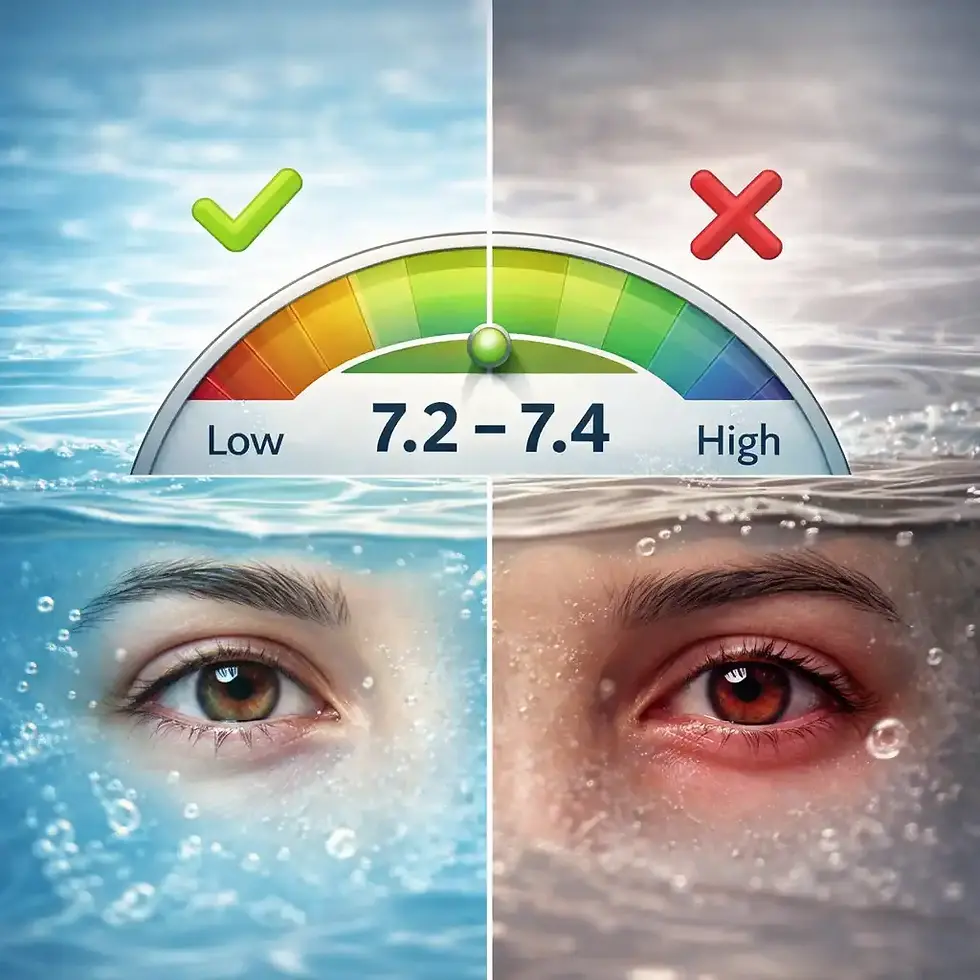
pH is a measure of how acidic or alkaline your pool water is. It’s expressed on a scale from 0 to 14, where 7 is neutral. Below 7, the water is acidic; above 7, it becomes alkaline. For a pool, the ideal range is between 7.2 and 7.4, this is the point where water is both comfortable for swimmers and optimal for treatment products.
Over time, an unbalanced pH can also impact your pool structure, especially sensitive elements like the liner. Understanding pool liner replacement helps anticipate damage and maintain your pool in the long run.
To make it clearer, here’s how to think about it in simple terms:
💧 pH defines how your water behaves
pH is not just a number—it determines how your pool water reacts on a daily basis. It influences clarity, comfort, and the overall effectiveness of your treatments. When pH is balanced, everything works smoothly; when it’s not, problems tend to appear quickly.

⚖️ Slightly above neutral is the sweet spot
While 7 is considered neutral, pool water performs best when it’s slightly above, between 7.2 and 7.4. This range closely matches the natural balance of the human body, making the water both comfortable for swimmers and ideal for maintaining stability.

🧪 pH controls chlorine efficiency
Chlorine doesn’t work in isolation—it depends entirely on the pH level. Even if you use the correct amount, its effectiveness drops significantly when pH is too high or too low, which often leads to cloudy water or persistent issues.

👀 It directly affects swimmer comfort
Water that is properly balanced feels almost invisible: no burning eyes, no dry skin, no discomfort. On the other hand, an incorrect pH can quickly make the swimming experience unpleasant, even if the water looks clean.
🏗️ It protects your pool over time
Beyond comfort, pH also plays a key role in preserving your pool. If it’s unbalanced, it can slowly damage liners, pipes, and filtration systems, leading to premature wear and higher maintenance costs.

👉 The simplest way to remember it: pH is the foundation of your pool. If it’s not right, nothing else works as it should.
2. Why pH matters more than you think
Many pool owners focus on chlorine, assuming it’s the main factor in water cleanliness. In reality, chlorine can only do its job properly if the pH is balanced.
When pH is too high, chlorine becomes less effective, even if you add more. This often leads to cloudy water or algae appearing unexpectedly. When pH is too low, the water becomes aggressive, causing irritation and potentially damaging equipment.
In other words, pH doesn’t just influence water quality, it directly affects comfort, efficiency, and long-term maintenance.
3. What happens when pH is not balanced
When pH drifts out of its ideal range, the effects are usually visible quite quickly.
With a high pH, water tends to lose its clarity. It may appear dull or cloudy, and you might notice deposits forming on pool surfaces or equipment. Chlorine seems ineffective, even when properly dosed.

With a low pH, the water becomes more corrosive. Swimmers may experience irritation, and over time, components such as liners, seals, or metal parts can deteriorate faster.
In both cases, the issue is not the treatment itself, but the environment in which it operates.
4. What makes pH move?
One of the most confusing aspects of pool maintenance is that pH never really stays still. Even when your water is perfectly balanced, it will naturally start to shift again. This is completely normal, pH is a dynamic parameter, constantly influenced by what happens in and around your pool.
Temperature plays a major role in how your pool behaves. As the water warms up, everything speeds up, especially chemical reactions. The result? pH tends to rise more quickly, which is why pools often feel harder to keep balanced during the summer, particularly in hot regions.
Pool usage adds another layer to this. Every swim introduces small, invisible elements into the water, sunscreen, sweat, and natural residues. On their own, they may seem insignificant, but over time, they gradually affect the water’s balance. The more the pool is used, the more these small changes accumulate, making regular adjustments necessary to keep everything under control.
Weather conditions further complicate things. Rain can dilute the water and disrupt its balance, while wind carries dust, pollen, and debris that affect water chemistry. Even something as simple as a storm can quickly change your pH levels without you noticing.
Filtration and circulation also have an influence. A well-functioning system helps stabilize the water, while poor circulation can lead to localized imbalances that spread over time.
In regions like Provence, these factors tend to combine. High temperatures, dry winds, and environmental exposure mean that pH can shift faster than expected, sometimes in just a few days.
👉 The key takeaway is simple: pH movement is normal. What matters is not stopping it, but monitoring it regularly and making small adjustments before it turns into a bigger issue.
5. How to keep pH under control
Maintaining pH doesn’t require complex actions, it requires consistency.
Regular testing is essential. Checking your water once or twice a week is usually enough to catch small variations early. When adjustments are needed, they should be made gradually. Overcorrecting often creates new imbalances.
With time, you’ll begin to understand how your pool reacts to different conditions, making maintenance more intuitive and less time-consuming.
6. Managing pH in a second home
Maintaining proper pH becomes more challenging when the property is not occupied year-round. Without regular monitoring, small imbalances can quickly escalate.
This is especially true in warm climates, where heat accelerates chemical reactions and algae growth.
In second homes, maintaining stable water balance can be more challenging without regular supervision. Discover practical advice on securing a pool in a second home in Provence to better protect and manage your property.
That’s why many owners rely on professionals like Var Villas Management. With regular checks and precise adjustments, they ensure consistent water quality and prevent issues before they arise.
Conclusion
If there’s one thing to remember, it’s this: pH is not something you fix occasionally, it’s something you keep stable over time.
When your pH is balanced, everything becomes easier. Your water stays clearer, your treatments work better, and your pool requires less effort overall.
Over time, stable water balance also helps preserve your pool equipment, liner and overall structure. For homeowners looking to better understand long-term pool maintenance and renovation in Provence, we also share practical advice in our guide on renovating the pool of your Provence home.
👉 Understanding pH is not about complexity—it’s about control.
A Personal Note 💬
💡My advice
During hot weather or periods of frequent use, check your pH more often than usual: ideally every 2 to 3 days. Small, regular adjustments are much easier (and cheaper) than correcting a fully unbalanced pool.
🌍 Did you know?
A rise in water temperature of just a few degrees can significantly accelerate chemical reactions, which is why pH often becomes unstable much faster in summer than in cooler seasons.


Commentaires